

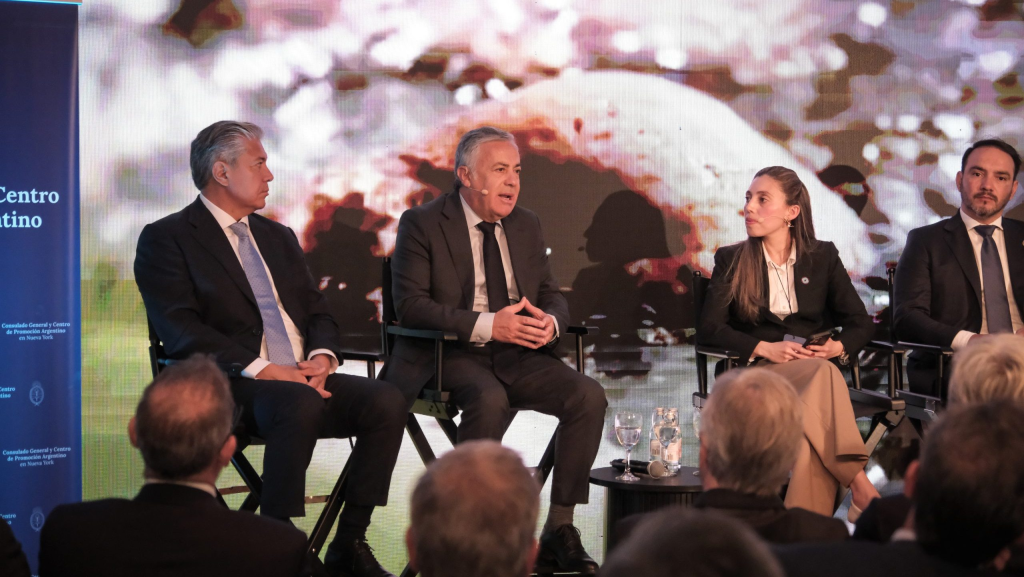
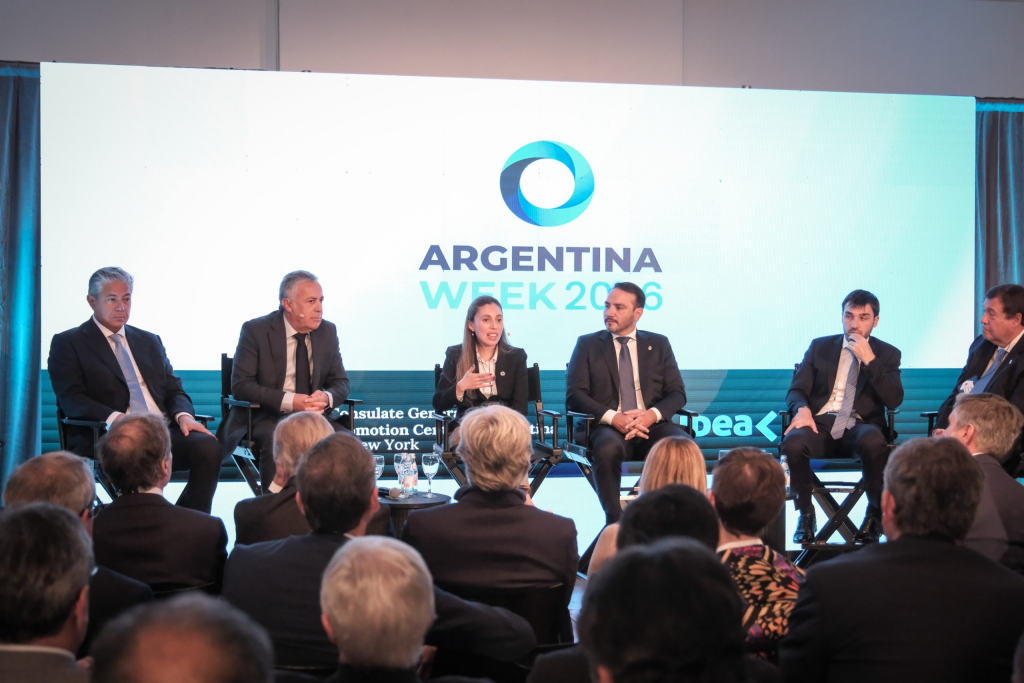
Governor Alfredo Cornejo highlighted Mendoza’s potential to become a logistics and financial hub for mining development in Argentina during a panel discussion organized as part of Argentina Week in New York. The event brought together Argentine provincial governors, national authorities and leading figures from the energy sector to analyze the country’s competitiveness and emerging investment opportunities.
The meeting was organized by the Consulate General and Promotion Center of the Argentine Republic in New York together with the Instituto para el Desarrollo Empresarial de la Argentina (IDEA). It convened representatives from both the public and private sectors to discuss the economic outlook and the role of strategic industries such as energy, mining and infrastructure.
During the event, Cornejo participated in sectoral roundtables and joined the Energy, Oil & Gas panel alongside governors Rolando Figueroa of Neuquén, Alberto Weretilneck of Río Negro, Juan Pablo Valdés of Corrientes and Ignacio Torres of Chubut. The discussion also included Argentina’s Minister of Economy Luis Caputo and the President and CEO of YPF, Horacio Marín.
Energy and infrastructure to drive mining investment
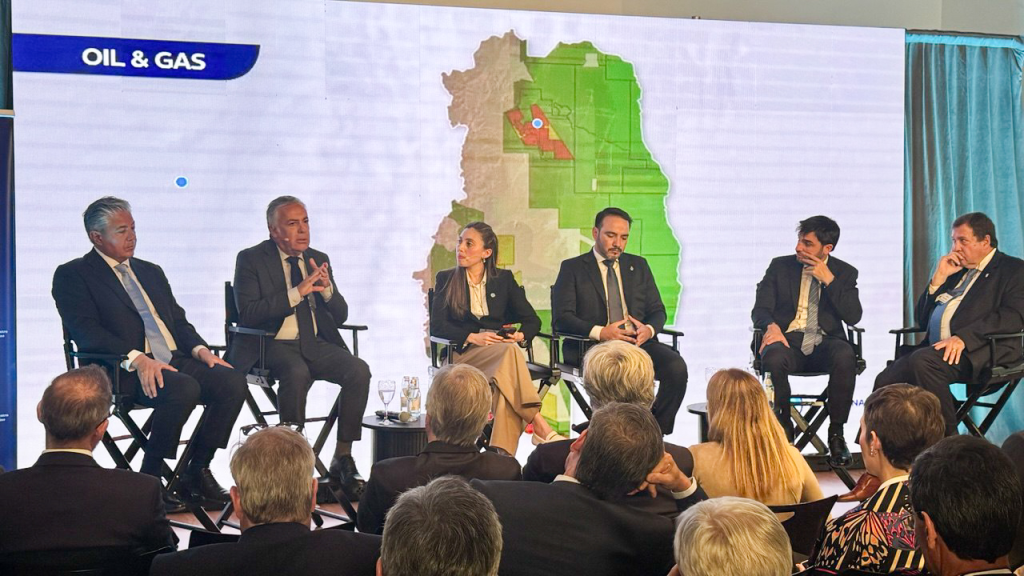
In his remarks, Governor Cornejo emphasized that Mendoza is strengthening its energy matrix to support the development of new productive sectors, particularly mining and energy projects.
He noted that Argentine provinces have authority over oil, energy and mining resources, but warned that macroeconomic stability remains essential for large-scale development.
“Provinces in Argentina have jurisdiction over oil, energy and mining, but without macroeconomic stability it is very difficult to fully develop those resources, even if projects and reserves exist,” he explained.
Cornejo stressed that energy infrastructure is fundamental for economic growth and for industries with high energy consumption.
“We need to generate much more energy, not only in Mendoza but across the entire country,” he said, noting that Argentina’s interconnected energy system requires greater capacity to support large productive projects.
He also highlighted Mendoza’s progress in renewable energy development. The province currently has around 700 megawatts of installed solar capacity, with plans to expand its renewable energy matrix in the near future. These investments, he noted, have been driven entirely by private companies.
“The 700 megawatts of solar power installed in Mendoza are the result of private investment. These are not provincial state projects but initiatives developed by companies that decided to invest in the province and are now expanding their operations,” he said.
According to the governor, energy diversification strengthens multiple sectors of the provincial economy.
“Energy supports mining, oil, tourism, agriculture and every productive activity. Having a solid base of renewable energy allows us to offer very attractive conditions for future projects,” he added.
Strategic mining projects
Cornejo also highlighted Mendoza’s mining potential, pointing to three strategic projects involving critical minerals linked to the global energy transition.
“We have three projects ready to move forward: the San Jorge copper project, the Sierra Pintada uranium project and the potash project in Malargüe. These are minerals that the United States has identified as critical and that require significant investment to begin production,” he said.
He added that copper production in Argentina could begin in the coming years.
“Argentina currently does not produce copper, but we are working to change that. Within a few years the country could begin producing this strategic mineral,” he stated.
Mendoza aims to become a logistics and financial hub
The governor also outlined Mendoza’s ambition to position itself as a logistics and financial center for mining development across Argentina.
He emphasized the province’s strategic geographic location and its connectivity with Pacific ports through Chile.
“We are working to develop a financial hub linked to mining,” Cornejo explained. “Mendoza has strong logistics capacity thanks to its connection with Chile, and we are building relationships with financial centers such as Toronto and Vancouver to facilitate project financing.”
He concluded that large-scale energy and mining development requires coordination between different levels of government and the private sector.
“For Argentina to become a global energy hub, three things are needed: coordination between provinces, the national government and the private sector. That coordination is beginning to happen,” he said.
Macroeconomic stability and geopolitical alignment
Argentina’s Minister of Economy, Luis Caputo, said that the week of meetings with governors and business leaders confirmed growing international interest in the country.
He argued that the current macroeconomic framework is essential for turning investment opportunities into real projects.
“The opportunities were always there because the resources were always there, but for many years the economic and geopolitical conditions were not in place,” Caputo said. “Today there is a clear geopolitical alignment and interest from the United States in particular, but also from the rest of the world.”
Caputo added that the stabilization process has already begun generating reactions in the real economy.
“Seeing international and local business leaders reacting so quickly to invest in the real economy is a strong sign that this is the right path,” he said.
He noted that in most stabilization processes financial investments tend to react first, while productive investments usually take longer due to their long-term nature and the need for predictability.
Caputo concluded that maintaining macroeconomic order, institutional stability and respect for rules will be key to attracting productive investments across Argentina.
Energy developments in Vaca Muerta and southern Mendoza
YPF President and CEO Horacio Marín also highlighted the strong international interest in Argentina’s energy sector and the scale of investments expected from the development of Vaca Muerta.
Marín announced that the company plans to drill new wells in the formation, including in southern Mendoza.
“This year we are planning to drill a couple of wells in Vaca Muerta in the south of Mendoza,” he said.
He also emphasized the scale of new infrastructure projects aimed at boosting energy exports, noting that they could generate up to $20 billion annually.
In the field of renewable energy, Marín highlighted the performance of solar projects in Mendoza and San Juan.
“The global average capacity factor for solar energy is around 17%. In San Juan with the Zonda winds and in Mendoza with El Quemado we are reaching around 31%,” he explained.
Marín also referred to the development of a liquefied natural gas (LNG) project in Río Negro, which could involve investments of up to $30 billion at peak construction.
He stressed that Argentina’s new investment framework, known as the RIGI regime, has been essential for enabling large-scale energy projects.
“Without RIGI it would have been much more difficult to move forward with the LNG development,” he said.
Promoting economic development
The Instituto para el Desarrollo Empresarial de la Argentina (IDEA), which organized the panel, brings together nearly 600 companies from different sectors and sizes, ranging from multinational corporations to small and medium-sized businesses.
According to the organization, these companies collectively generate approximately 50% of Argentina’s GDP and private employment.
Through forums, professional networks and multisector dialogue platforms, IDEA promotes initiatives aimed at strengthening Argentina’s economic, social and institutional development while encouraging collaboration between the business community and public sector leaders.