


During the U.S.-Argentina Critical Minerals Forum, Governor Alfredo Cornejo highlighted Mendoza’s technical capabilities, logistics infrastructure and connectivity to Pacific ports. He also said Argentina is facing a historic opportunity driven by growing global demand and stressed the need to maintain the country’s economic course, strengthen infrastructure and coordinate efforts among the federal government, provinces and the private sector.
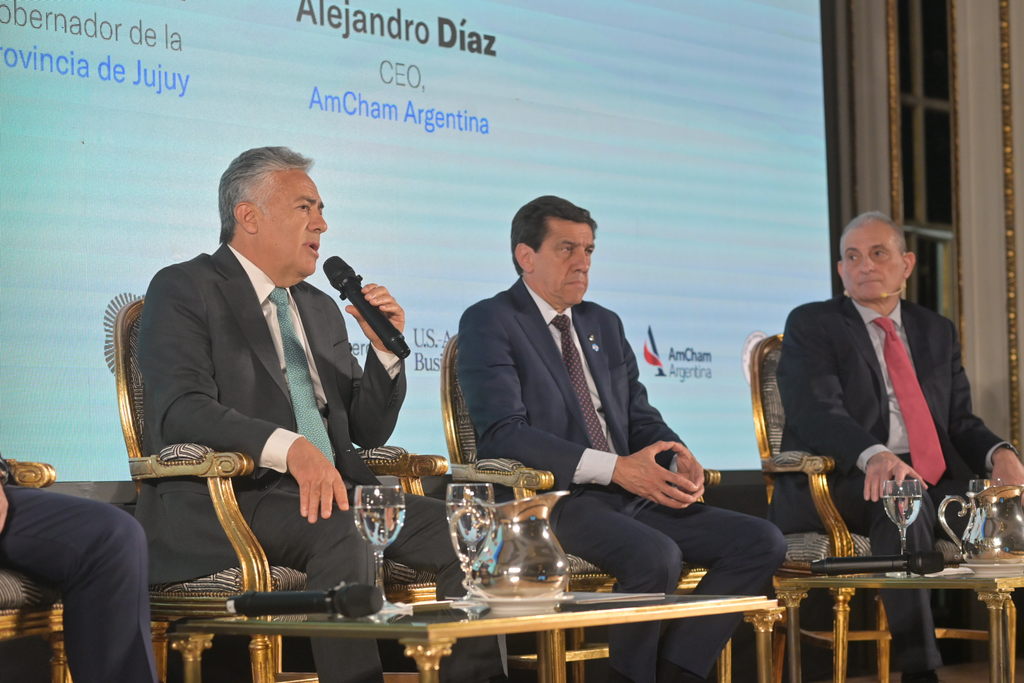
Governor Alfredo Cornejo participated Thursday in the “Conversation with Governors” held as part of the U.S.-Argentina Critical Minerals Forum at the Alvear Hotel in Buenos Aires. During the panel, he outlined Mendoza’s competitive advantages and the conditions the province has built to attract investment, develop long-term projects and integrate into global supply chains.
The discussion also featured Jujuy Governor Carlos Sadir and Santa Cruz Governor Claudio Vidal and was moderated by AmCham Argentina Executive Director Alejandro Díaz. The forum brought together officials from Argentina and the United States, private-sector executives, development finance institutions and diplomatic representatives. Mendoza’s Minister of Energy and Environment, Jimena Latorre, also attended the event.
During his remarks, Cornejo argued that developing Argentina’s mining potential requires two key conditions to come together: macroeconomic stability at the national level and provinces willing to promote investment, streamline procedures and provide clear rules.
“Argentina has not historically been a mining country when compared with Chile or Peru,” Cornejo said, adding that changing that reality requires “a combination of macroeconomic stability and provinces that are investment-friendly, streamline permitting and are open to developing the industry.”
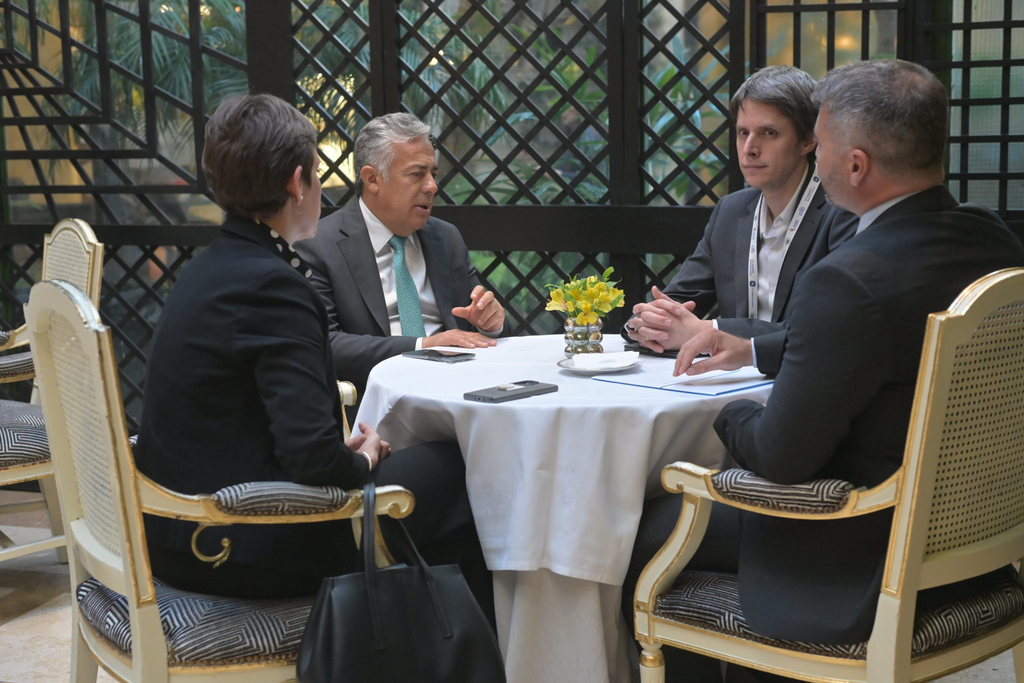
The Governor highlighted the shift in Argentina’s business climate and growing international demand for critical minerals, particularly copper.
“There is a window of opportunity that Argentina cannot afford to miss. We must stay the course and work together to take advantage of it,” he said.
Infrastructure and Coordination to Accelerate Investment
Cornejo emphasized that having mineral resources alone is not enough to ensure projects move forward. For that reason, he said infrastructure investment must be coordinated among the federal government, provincial governments and the private sector.
“Having the resources means little if we cannot get them to market efficiently and on time. We need a technically sound assessment of what infrastructure is required and how it will be financed over the short, medium and long term,” he explained.
Among the main priorities, the Governor cited the construction and improvement of roads, the development of rail infrastructure and the expansion of electricity transmission networks.
“All of these projects require private financing as well as a commitment from the federal government, not just the provinces,” he said.
Cornejo also highlighted the Mendoza Government’s investments in road, energy and logistics infrastructure, as well as the province’s strategic location and connectivity to Pacific ports.
“Mendoza has the main corridor to Pacific ports, strong hotel infrastructure, quality services, transportation and steadily improving air connectivity,” he said.
Mendoza’s Competitive Advantages
Cornejo noted that although large-scale metal mining is still at a relatively early stage of development in Mendoza, the province has decades of knowledge, professional expertise and specialized companies connected to the industry.
He said Mendoza has an established mining culture, universities and academic institutions, a strong supplier base and a highly skilled workforce.
“Many professionals and companies from Mendoza provide services in Chile, Peru and other countries. Now those capabilities can be put to work for the province’s own development,” Cornejo said.
Asked why a company should choose Mendoza for its next investment, the Governor highlighted the province’s key advantages.
“The province contributes to the basic infrastructure projects require, offers low taxes, a favorable business climate, a skilled workforce and legal certainty,” he said.
Cornejo particularly emphasized that environmental procedures related to mineral exploration and development involve legislative approval and broad institutional support.
“Approvals are enacted by law and have received very broad majorities. Combined with the RIGI investment incentive regime, this provides predictability and guarantees for the development of long-term projects,” he said.
Mendoza’s Relationship With the United States
Cornejo also highlighted Mendoza’s longstanding relationship with the United States across several productive sectors. As an example, he referred to the transaction through which the provincial and federal governments sold their shares in IMPSA to a U.S.-backed investment fund.
“Mendoza has always been a partner of the United States. That relationship did not begin with my administrations; it has traditionally been built through the province’s ties with different industries,” he said.
The U.S.-Argentina Critical Minerals Forum was jointly organized by the U.S. Chamber of Commerce, the U.S.-Argentina Business Council, Citi, AmCham Argentina and the U.S. Embassy in Argentina.
The event aimed to strengthen bilateral cooperation and explore mechanisms to unlock Argentina’s mineral potential, attract investment and build secure supply chains amid growing global demand for critical minerals.