

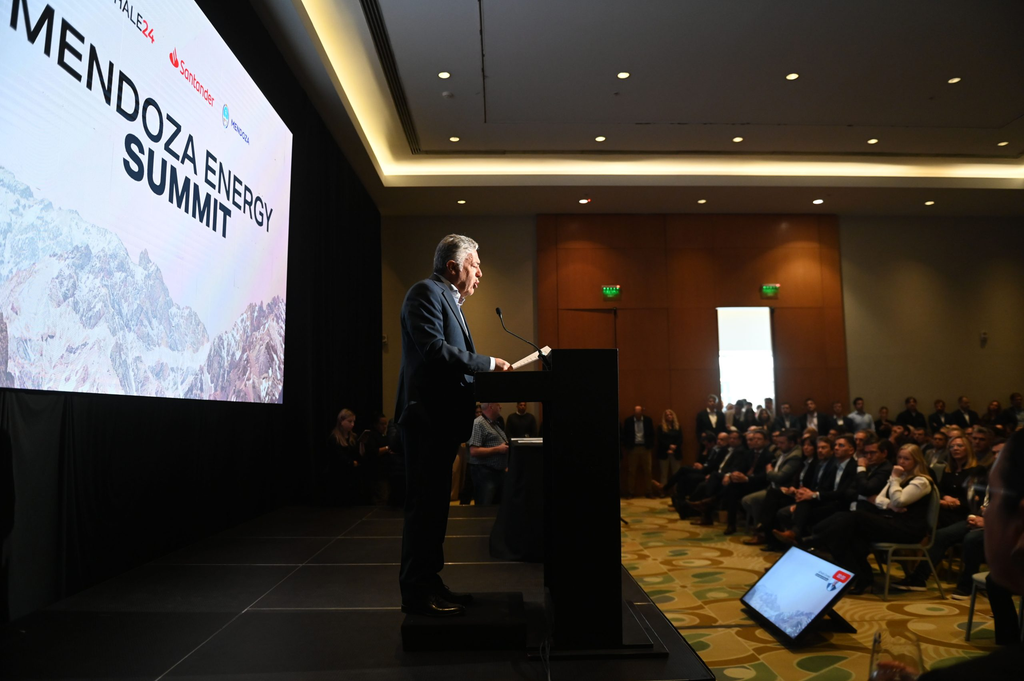
Mendoza is hosting the summit, which brings together executives and representatives from leading energy, oil and gas, and mining companies from across Argentina. Governor Alfredo Cornejo opened the Mendoza Energy Summit 2026 by highlighting the transformation underway across the province’s energy
Governor Alfredo Cornejo opened the Mendoza Energy Summit 2026, a conference bringing together leaders from Argentina’s energy and mining industries to discuss investment opportunities and the challenges posed by the sector’s transformation at both the national and regional levels.
The event, held at the Hilton Mendoza, is organized by the Government of Mendoza, Shale24 and Santander and has drawn representatives from more than 150 companies.
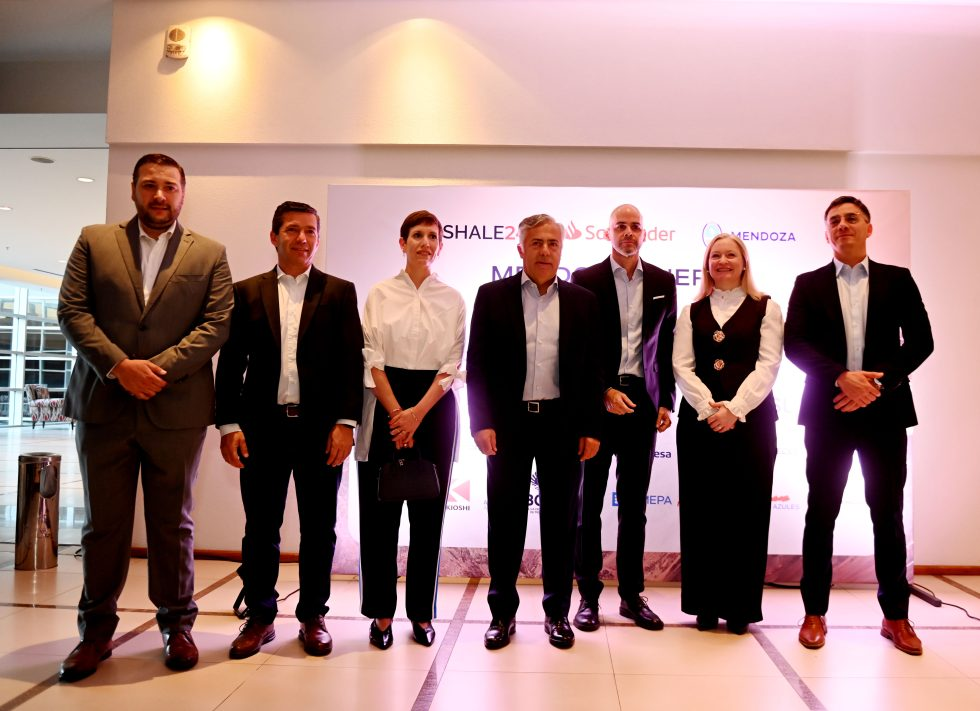
The opening session was attended by Lieutenant Governor Hebe Casado; Energy and Environment Minister Jimena Latorre; Production Minister Rodolfo Vargas Arizu; President of the Chamber of Deputies Andrés Lombardi; Guaymallén Mayor Marcos Calvente; and national lawmakers Lisandro Nieri and Pamela Verasay.
Also attending were Undersecretary of Energy and Mining Manuel Sánchez Bandini; Mining Director Jerónimo Shantal; Hydrocarbons Director Lucas Erio; EMESA General Manager Mauricio Pinti Clop; and Shale24 Director Julián Guarino.
In his opening remarks, Cornejo highlighted the transformation of Mendoza’s energy sector and the scale of the private-sector turnout.
“We are honored to welcome everyone visiting us here in Mendoza. We are impressed by the turnout, with more than 150 companies represented. Thank you for being here. A few years ago, we were still debating whether we wanted to become an energy province. Today, we can say that Mendoza is already an energy province,” Cornejo said.
He reviewed the expansion of oil and gas activity and the new opportunities emerging in both exploration and production. Mendoza has adopted a continuous bidding system for oil and gas areas, and nine areas have already been awarded during Cornejo’s second term, with investment commitments from eight companies. More than 1,000 square kilometers are now under new exploration programs that include drilling commitments.
Cornejo cited the extension of the Malargüe cluster to Venoil as one example. The agreement includes a $150 million investment commitment through 2037 for new wells, the reactivation of inactive wells and the use of enhanced oil recovery technologies. He also highlighted two new exploration permits for Atuel Exploración Sur and Río Atuel.
The governor said YPF’s exit from mature fields did not interrupt production in Mendoza’s affected areas.
“We changed the approach. Instead of simply administering contracts, we began managing a portfolio. We introduced faster processes, very specific administrative changes, early contract extensions and incentives tied to investment. And, of course, we took on a significant political cost in the negotiations with YPF over Plan Andes,” Cornejo said.
He explained that Plan Andes helped reshape Mendoza’s operator landscape and noted that all companies currently operating under that framework were represented at the summit. According to Cornejo, the program accounts for more than $950 million in committed investment, while the nine areas awarded during his second term under the continuous bidding system represent more than $80 million in commitments. Overall exploration commitments total approximately $1 billion.
Cornejo also addressed the development of Vaca Muerta in Mendoza, noting that approximately 30% of the geological formation lies within the province.
“An exploration drilling campaign will begin in Mendoza’s Vaca Muerta in October. It includes three new wells, three wells by YPF itself, and two wells in Cañadón Amarillo by Tercera Vía Quintana. The Cañadón Amarillo project involves an initial investment of $44 million over the first three years, with potential investment of up to $350 million if the pilot confirms the expected results,” he said.
The governor also discussed Mendoza’s efforts to attract long-term investment and linked that strategy to the modernization of the province’s regulatory framework.
Earlier Friday, Energy and Environment Minister Jimena Latorre presented a bill to the provincial Legislature proposing changes to Hydrocarbons Law 7,526. The legislation has been in place for nearly two decades, and the proposed overhaul is designed to reflect an industry in which Mendoza is now pursuing both conventional and unconventional development.
Cornejo said the proposed framework includes royalty structures and incentives designed to encourage investment and reserve development, along with stronger environmental requirements and rules governing the coexistence of oil and gas and mining projects.
“No one signs these contracts without rules that can stand the test of time, backed by laws that have broad support, like the legislation we submit to the Legislature and that receives strong majorities. That is what a provincial government can offer the private sector, and that is exactly what Mendoza and my administration are offering,” he said.
At the end of his remarks, Cornejo said the private sector must now take the lead in turning those opportunities into projects and production.
“We believe the Province of Mendoza has done its part. It must continue to fulfill the regulatory role established by the Constitution and provide clear, straightforward laws like the one we are now submitting to the Legislature. Now it is up to the companies. They must honor the contracts they have already signed with Mendoza, use new technologies to further develop conventional resources and be willing to take the risks required to develop Mendoza’s unconventional resources,” he said.
Building a Stronger Local Oil and Gas Supply Chain
Mendoza has also added the oil and gas supply chain to the Supplier Development Program, an initiative of the Federal Investment Council (CFI) that the Province joined through a formal agreement. The program combines technical assistance, financing, guarantees and business development tools to strengthen strategic value chains.
The initiative is already operating across several sectors of Mendoza’s economy and is now expanding into oil and gas as activity grows, new operators enter conventional fields and development moves forward in Mendoza’s portion of Vaca Muerta.
The provincial government’s goal is to help local companies become more competitive and grow alongside the industry.
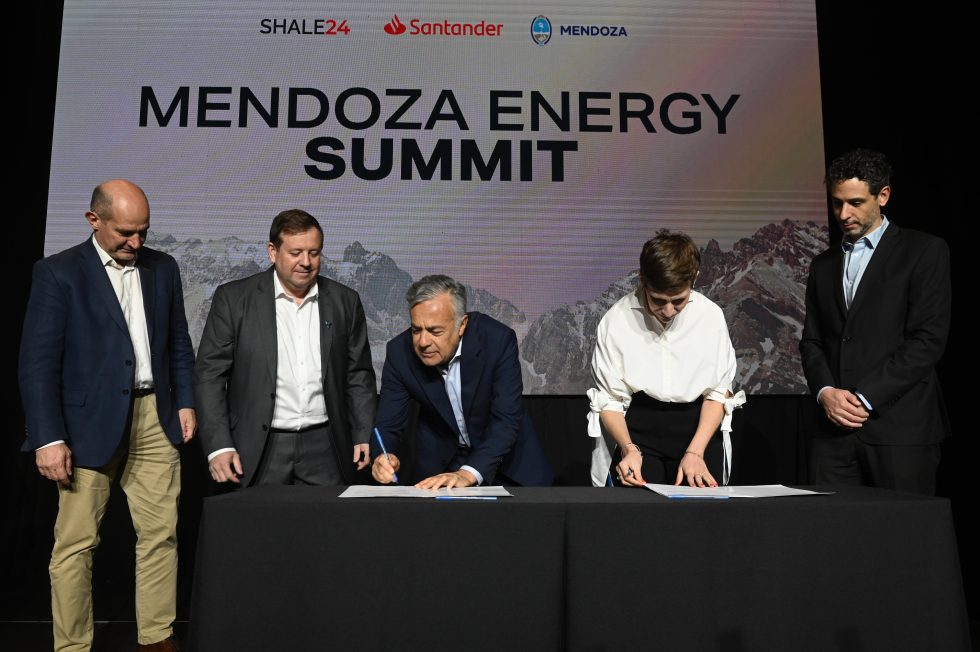
Following the opening of the Mendoza Energy Summit 2026, PCR and Venoil Energía signed the first letters of participation in the oil and gas Supplier Development Program. Both operators will participate as anchor companies.
Under the program, the companies will identify and recommend small and medium-sized Mendoza suppliers that could benefit from its resources. They will also work with CFI and the provincial government on initiatives aimed at improving the competitiveness of the local supply chain.
The program is designed to help Mendoza-based small and medium-sized businesses strengthen their technical, operational and management capabilities, gain access to better financing options and expand their participation in the oil and gas industry.
The signing was attended by Governor Alfredo Cornejo; Energy and Environment Minister Jimena Latorre; Diego Silva, representing the Federal Investment Council; PCR Argentina Oil and Gas Director Marcelo Irusta; Venoil Energía President and CEO Gustavo Naves; and Undersecretary of Energy and Mining Manuel Sánchez Bandini.
Industry Leaders Gather in Mendoza
The summit also features executives including Genneia CEO Bernardo Andrews, YPF Luz CEO Martín Mandarano, Transener CEO Pablo Tarca, Distrocuyo CEO Edgardo Fonoll and IMPSA President Jorge Salcedo.
Oil and gas industry participants include Horacio Bustillo, Pablo Iuliano, Carlos Gilardone, Gustavo Naves and Alfredo Bonatto. Mining sector representatives include Fabián Gregorio, Matías Berardini and Sebastián Piña.
The Mendoza Energy Summit 2026 agenda covers oil and gas, power generation, renewable energy, mining, transmission and power grids, battery energy storage systems (BESS), hydropower, infrastructure, financing, regulation and supplier development.