

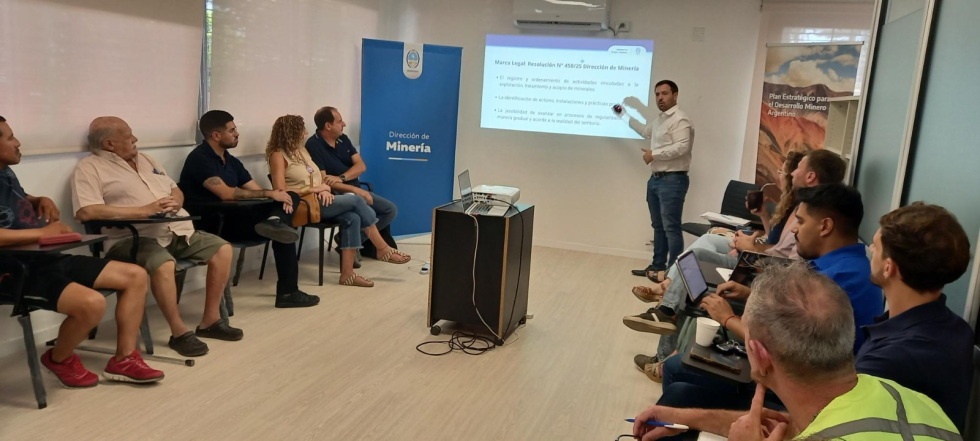
A new working meeting held at the Mining Directorate marked further progress in organizing brickmaking activities, classified under third-category mining, while providing tools to support a regulated and sustainable production model.
The meeting forms part of an ongoing series of dialogue spaces aimed at advancing the orderly development of the brickmaking sector, promoting compliance with the regulatory framework and addressing its productive, social, and environmental dimensions in an integrated manner.
The Ministry of Energy and Environment of Mendoza, through the Mining Directorate and the Environmental Management and Enforcement Directorate, led a new working session with provincial brickmakers. Representatives from the Municipality of Las Heras and local residents also took part in the meeting, which focused on continuing the process of sector organization and regulatory alignment.
“The meeting was held at the Mining Directorate’s headquarters and is part of a series of dialogue and joint-building efforts the Ministry has been promoting since last year to address the brickmaking sector in a comprehensive way, taking into account its productive, social, and environmental characteristics,” explained Jerónimo Shantal, Director of Mining.
During the meeting, technical teams from the Mining Directorate and the Environmental Management and Enforcement Directorate outlined the administrative and technical procedures required to regularize the activity. They detailed the scope of each process, the responsibilities of the different agencies involved, and the tools available to support producers throughout the transition.
“The exchange took place in a constructive and collaborative atmosphere, with a strong willingness to engage from both producers and public agencies. The meeting created space to listen to each participant’s specific situation and to clarify questions related to formal requirements, timelines, and the support mechanisms in place,” Shantal added.
Regularizing these activities is essential not only to ensure compliance with existing regulations, but also to improve production conditions, reduce environmental impacts, and promote harmonious coexistence with nearby communities.
Coordinated Work and Ongoing Support
As a result of the meeting, the parties agreed on several lines of action aimed at consolidating a gradual, coordinated approach with sustained institutional support:
Joint work among participating agencies to streamline administrative processes, avoid duplication, and promote clearer, more efficient procedures.
A shared commitment by the Municipality of Las Heras and the Ministry of Energy and Environment to work collaboratively in supporting the sector.
The continuation of working tables with producers, focused on the progressive organization of the activity and the improvement of productive, environmental, and territorial conditions.
At the close of the meeting, participating institutions highlighted the historical, cultural, and productive importance of brickmaking in the province. They also reaffirmed the need to maintain a gradual transition approach that takes into account the realities of the sector, environmental stewardship, and social coexistence.
Background of a Sustained Policy
This new working session builds on actions initiated last October, when the Mining Directorate and the Ministry’s Sustainability Coordination convened a multisectoral meeting to address the situation of small-scale brickmakers in a comprehensive manner.
That earlier meeting, also held at the Mining Directorate’s headquarters, brought together municipalities, provincial agencies, and representatives of the productive sector. It enabled an in-depth discussion of the current context of the activity, which faces environmental, social, and production-related challenges.
Representatives from the municipalities of Guaymallén, Las Heras, and Lavalle participated, emphasizing the need for technical assistance and state support to improve production conditions and move toward formalization.
These initiatives are part of a public policy framework aimed at integrating social inclusion, labor formalization, and environmental sustainability, recognizing brickmaking as a key component of Mendoza’s productive and cultural fabric.