

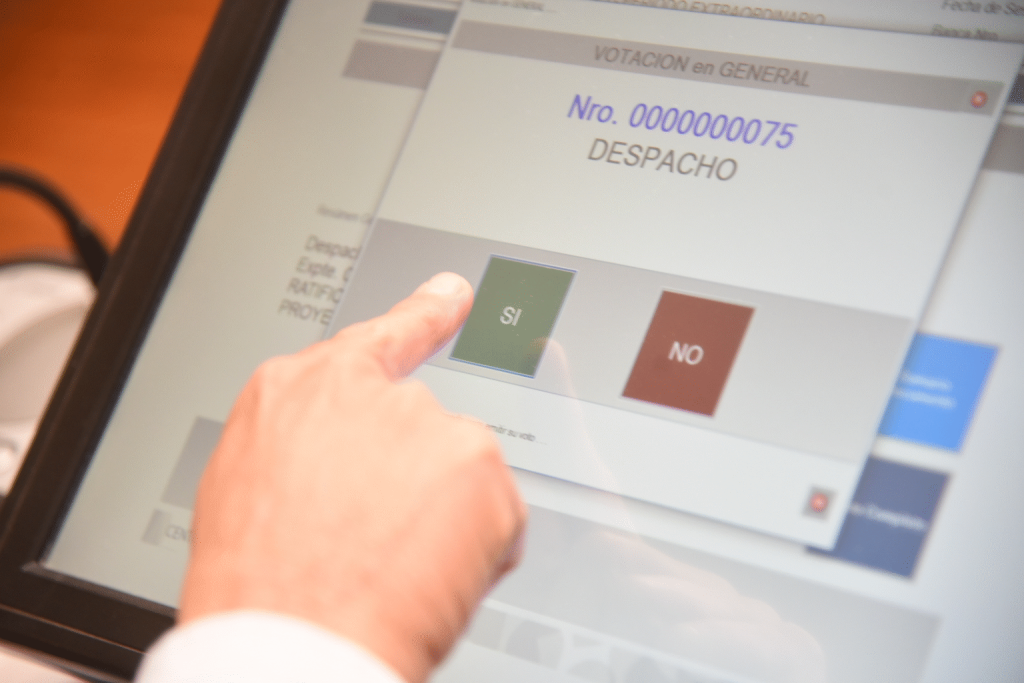
With the Senate’s approval of the Environmental Impact Declaration for PSJ Cobre Mendocino, the second phase of the Malargüe Western Mining District, the new Mining Royalty Regime, and the Environmental Compensation Fund, Mendoza has strengthened the institutional framework needed to launch a new stage of copper production under the country’s highest environmental standards.
With the Senate’s approval of the Environmental Impact Declaration (EID) for PSJ Cobre Mendocino, the second phase of the Malargüe Western Mining District, the new Mining Royalty Regime, and the Environmental Compensation Fund, Mendoza has consolidated the institutional foundation that enables the province to advance a new stage of mining development and diversify its productive matrix—while adhering to the most rigorous environmental safeguards in Argentina.
This legislative package marks the formal launch of a comprehensive public policy—one that integrates economic development, interdisciplinary environmental oversight, and a regulatory framework designed to guarantee transparency and long-term sustainability throughout the mining process.
PSJ: Copper Production for the Global Energy Transition
The final approval of the PSJ Cobre Mendocino EID concludes an extensive evaluation process that included broad citizen participation and review by multiple sectoral agencies.
Nearly one hundred technical experts, sixteen agencies, the Interdisciplinary Environmental Mining Evaluation Commission, and the Provincial Environmental Council contributed to the assessment. Public workshops and a ten-day hearing generated more than 9,500 citizen submissions, an unprecedented level of participation in the province.
All documentation—such as reports from the Mining Directorate, the Environmental Management and Oversight Directorate, the FUNC technical report, and sectoral evaluations—was made publicly available from the beginning, reinforcing a governance model built on transparency, traceability, and institutional accountability.
PSJ Cobre Mendocino involves an initial investment of USD 559 million, an estimated construction period of 18 to 24 months, and an operational life of 16 years, potentially extendable to 27.
The project was designed with preventive water- and energy-efficiency criteria, including more than 80% internal water recirculation, low-impact modern technology, and a cross-cutting sustainability strategy that balances social, environmental, and economic dimensions.
Its development will position Mendoza within the global supply chain for a mineral that is critical to the energy transition, at a time when global copper demand is shaping the expansion of clean technologies, electric mobility, and next-generation power grids.
Malargüe Western Mining District II: Impulsa Mendoza’s Proposal for Development
In parallel, the Legislature approved the Environmental Impact Declaration for Malargüe Western Mining District II (MDMO II), which incorporates 27 new exploration projects across the area delineated, studied, and proposed by Impulsa Mendoza.
The technical evaluation process included contributions from the General Department of Irrigation; the municipalities of Malargüe and Las Heras; the Directorates of Protected Areas, Cultural Heritage, Livestock, Biodiversity and Ecopark; as well as the departments of Hydraulics and Hydrocarbons, the Territorial Planning Directorate, INAI, Ianigla-Conicet, and the UNCuyo Faculty of Applied Sciences to Industry. All related reports have been made publicly available.
Energy and Environment Minister Jimena Latorre noted that the province already has 34 approved EIDs under MDMO I. With this new package, Malargüe will reach 65 exploration projects with environmental authorization, while another 71 proposals linked to Phase III continue under review. The district also incorporates specific management plans for areas above 2,600 meters, developed using recommendations from Ianigla and the National Environment Secretariat, positioning Mendoza as a national benchmark for environmental compliance in mining.
Mining Royalties and the Environmental Compensation Fund
The legislative session also endorsed the new Mining Royalty Regime, which updates the calculation and allocation mechanisms for mining royalties. The law establishes a minimum royalty rate of 3% of mine-mouth value, expandable to 5% for new projects, while reinforcing the province’s fiscal role in the responsible use of its natural resources. The framework strengthens tax clarity, regulatory predictability, and the foundations of a modern fiscal policy capable of supporting sector growth without compromising institutional responsibility.
The Legislature also approved the creation of the Environmental Compensation Fund, a dedicated financial instrument intended exclusively for addressing collective ecological damage, remediation, restoration, environmental monitoring, and environmental infrastructure projects. The fund will be financed through royalties, fines, contributions linked to new EIDs, legal recoveries, and specific allocations. Its design reflects a core principle of Mendoza’s environmental policy: mining development must be backed by a permanent structure for prevention, oversight, and repair.
A New Landscape for Responsible Mining in Mendoza
Together, these four laws open an unprecedented scenario for the province. Mendoza is advancing toward a mining sector built on verifiable environmental standards, clear fiscal frameworks, strong compensation mechanisms, and an institutional process subject to multiple layers of academic, technical, and civic review.