

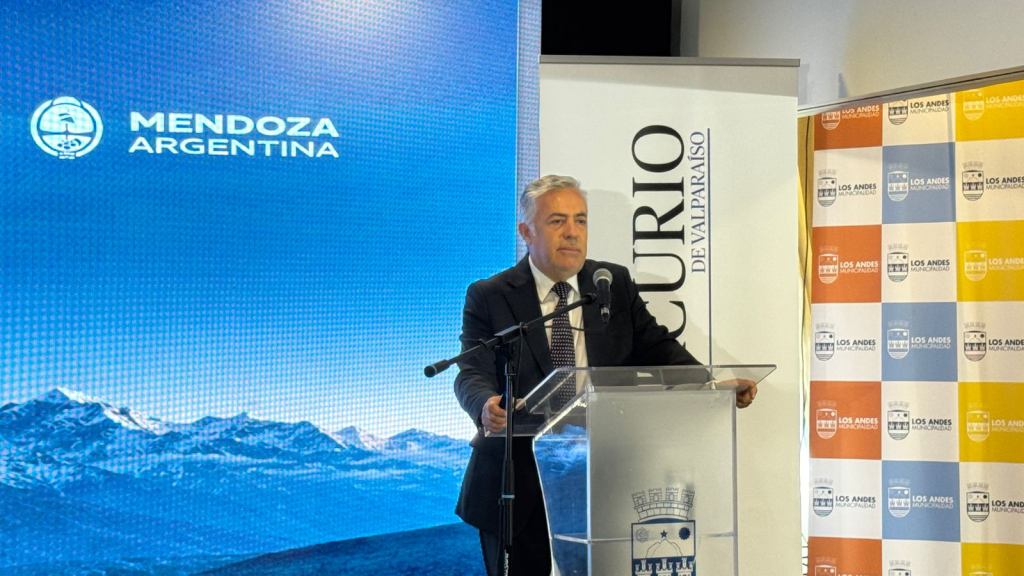
Governor Alfredo Cornejo made the announcement during an international mining forum that brought together Argentine and Chilean authorities to discuss mining development, logistics, and the strategic role of the Los Libertadores Border Crossing in strengthening integration between the two countries.
Governor Alfredo Cornejo participated as a keynote speaker at the international forum “The Mountain Range That Unites: Binational Mining and the Los Libertadores Border Crossing as Strategic Pillars of Chile–Argentina Integration,” held in Los Andes, Chile, where he announced that Mendoza will host the Second International Summit on Sustainable Mining on November 19–20, 2026.
Cornejo made the announcement at the conclusion of his presentation, inviting government officials, business leaders, investors, and industry representatives to attend the summit, which will once again bring together national and international experts to discuss the future of modern, sustainable mining and regional integration.
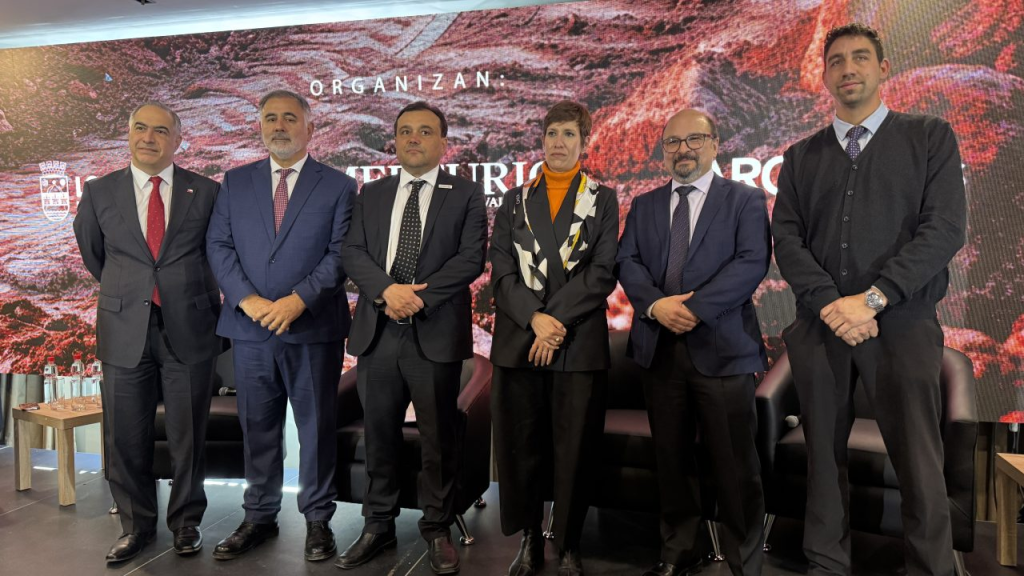
The event gathered national, provincial, regional, and municipal authorities, along with private-sector representatives from both Argentina and Chile, to strengthen bilateral cooperation and promote the development of mining, energy, logistics, ports, and infrastructure along the international trade corridor.
Mendoza vuelve a estar en el epicentro de la minería mundial. Hoy anuncié que realizaremos la Segunda Cumbre Internacional de Minería Sostenible, el próximo 19 y 20 de noviembre, aprovechando nuestra visita a Chile para participar del encuentro internacional "Cordillera que une:… pic.twitter.com/O9LIrA1o8n
— Alfredo Cornejo (@alfredocornejo) June 26, 2026
During his presentation, Cornejo outlined Mendoza’s strategy to establish mining as one of the key drivers of economic diversification, quality job creation, and long-term investment, supported by sustainability principles and close public-private collaboration.
He emphasized that the Andes Mountains should no longer be viewed as a barrier, but rather as a shared platform for integration through tourism, energy, and sustainable mining. He also highlighted that Mendoza and Chile share the same metallogenic belts, containing significant reserves of copper, gold, silver, iron, lithium, uranium, and potash, creating major opportunities for joint development on both sides of the Andes.
The Governor explained that one of Mendoza’s greatest challenges is developing a socially supported mining industry.
“We are fully committed to ensuring that the State can provide permitting processes that are both efficient and technically rigorous, combining speed with strong environmental protection.”
Cornejo also highlighted that Mendoza has introduced a new legal framework allowing entire mining districts to be approved by the Provincial Legislature, providing greater legal certainty and predictability for investors. This system has already enabled the approval of 65 mineral exploration projects within a portfolio of approximately 200 planned initiatives, with broad political support.
He reminded attendees that, under Argentina’s federal system, provinces have constitutional authority over their mineral resources and are responsible for issuing mining permits.
Cornejo also presented PSJ Cobre Mendocino as the province’s most advanced mining project, noting that it is expected to become the first of Argentina’s new generation of large-scale copper operations to enter production. He further emphasized that the project has been approved under Argentina’s Large Investment Incentive Regime (RIGI), strengthening the conditions for attracting long-term investment.
The Governor stressed that Mendoza offers a competitive business environment built on fiscal responsibility, respect for contracts, and clear rules for investors. These conditions are complemented by the modernization of the Provincial Mining Procedure Code, new tax incentives for strategic projects, and enhanced transparency and public participation mechanisms.
Regarding infrastructure, Cornejo explained that Mendoza is investing in power transmission, highways, and high-voltage electrical networks to support both future mining developments and the province’s broader productive sectors.
On regional integration, he proposed strengthening a shared agenda between Mendoza and Chile’s Valparaíso Region through logistics corridors, service hubs, railway infrastructure, and continued improvements to the Los Libertadores International Border Crossing.
“There is no reason for us to see each other as competitors. We need to reduce costs and ensure companies choose the most efficient logistics corridors.”
Concluding his remarks, Cornejo reaffirmed the importance of deepening cooperation between Chile and Mendoza to capitalize on the growing global demand for critical minerals and energy.
“We do not want to see the Andes as a barrier, but as a shared platform to generate development, employment, and investment for both countries.”
Mendoza’s participation in the forum reinforces the Provincial Government’s commitment to strengthening its integration agenda with Chile while promoting the Los Libertadores Border Crossing as strategic infrastructure for trade, production, and the development of new mining projects.
The Mendoza delegation included several provincial officials, among them Minister of Energy and Environment Jimena Latorre, who also participated in a panel discussion alongside representatives from government agencies and companies involved in mining, energy, logistics, and port development.
The event was opened by Manuel Rivera, Mayor of Los Andes. Additional keynote speakers included Francisco Pérez Mackenna, Chile’s Minister of Foreign Affairs, and Rodrigo Mundaca, Governor of the Valparaíso Region. Both emphasized the importance of strengthening Chile–Argentina cooperation to advance mining, logistics, energy development, and regional competitiveness.