

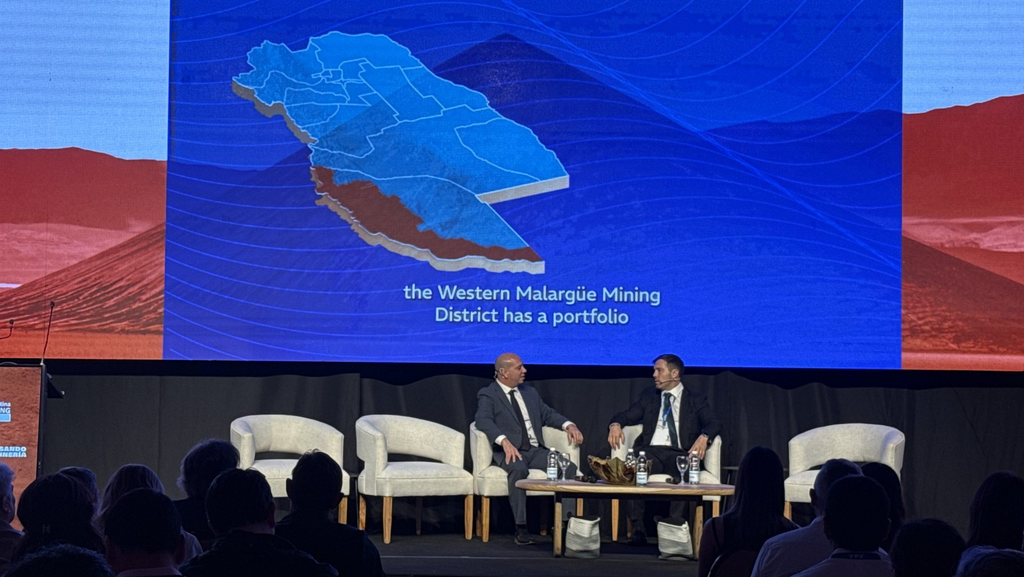
Planning, regulatory compliance, environmental requirements and legislative support were among the key pillars highlighted by Mendoza’s Mining Director. Shantal emphasized the progress made by the province to provide predictability, legal certainty and the conditions needed for the sustainable growth of the mining industry.
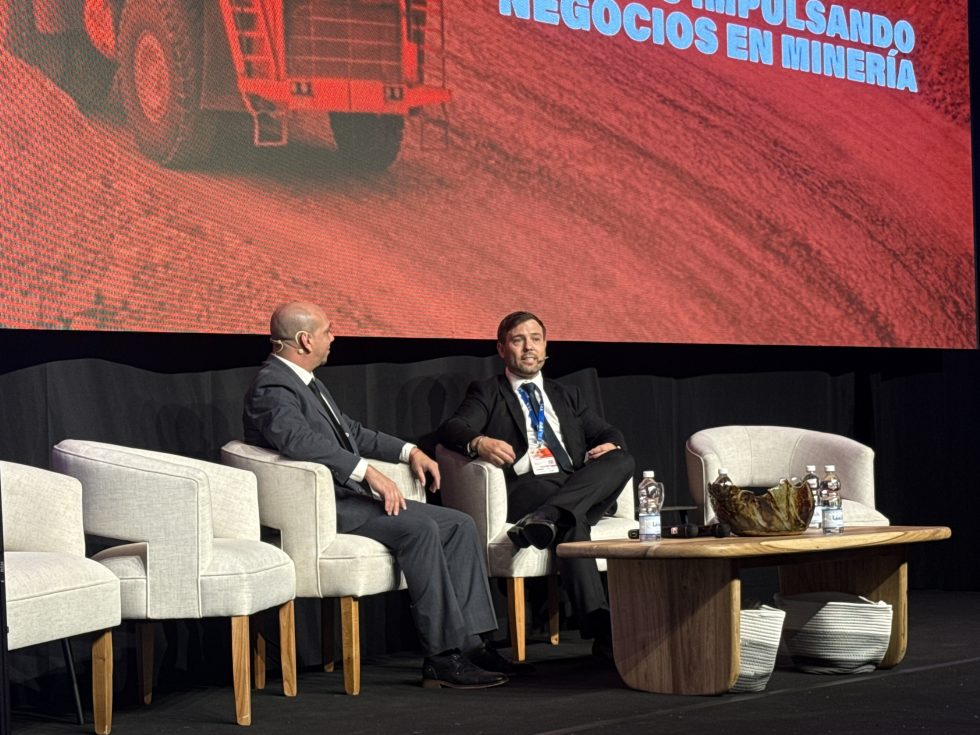
Jerónimo Shantal, Mining Director at Mendoza’s Ministry of Energy and Environment, was one of the speakers at Argentina Mining 2026, one of the country’s leading mining industry events. Mendoza Vice Governor Hebe Casado joined him during his presentation.
Under the title “Mendoza: Ready to Consolidate Its Mining Development. A Province That Has Built the Conditions to Move Forward,” Shantal outlined the process undertaken by the province to launch a new stage of mining development.
During his presentation, Shantal pointed to the arrival of BHP, the world’s largest mining company, as a concrete example of the results achieved. BHP recently entered into a strategic alliance with Canadian company Kobrea Exploration to advance copper exploration projects in Mendoza.
“We have very high expectations, especially following the recent BHP announcement. We are extremely proud that the world’s number one mining company is coming to Mendoza and placing its trust in the province. What we have been saying and demonstrating is now reflected in a concrete development: BHP is coming to Mendoza and, specifically, to Malargüe,” Shantal said.
The Mining Director also highlighted how dramatically the province’s mining landscape has changed in just a few years.
“We are already seeing exploration activity and geologists working in the field, when less than three years ago the situation was completely different,” he said.
Shantal attributed this transformation to a long-term and sustained effort.
“I believe this has been achieved through a process led by Governor Alfredo Cornejo; Vice Governor Hebe Casado; Minister of Energy and Environment Jimena Latorre; industry chambers; Fundación Plan Pilares; universities; and other organizations in Mendoza that have been working together to develop this strategy. Today, we can say that Mendoza, in addition to being the land of sunshine and fine wine, is also becoming a land of energy and mining.”
Three Strategies for Mining Development
Shantal summarized Mendoza’s approach around three major strategies. The first was to establish from the outset the rules under which mining activity would be developed.
“The first decision was that we were going to develop mining under the regulations currently in force and with requirements that, in some cases, are even more stringent,” he explained.
The second pillar was the development of mining districts, an approach that made it possible to evaluate multiple exploration projects together while maintaining the required environmental and legislative review processes.
“This helped us narrow the gap created during the years when Mendoza was effectively closed to mining: assessing several environmental impact reports for exploration projects within a single administrative proceeding and then submitting them to the Legislature,” he said.
Shantal emphasized that Environmental Impact Declarations must be ratified by the provincial Legislature and highlighted the level of legislative support achieved. Mendoza currently has 69 projects with approved declarations, another 71 under evaluation, and is moving forward with the creation of the Mendoza Norte Mining District.
The third strategy is to move from exploration toward production. In this context, Shantal highlighted PSJ Cobre Mendocino, whose environmental review involved more than 15,000 pages of administrative proceedings, free, prior and informed consultation processes, a 10-day public hearing with more than 3,500 registered participants and 850 speakers, followed by legislative ratification.
“The third strategy is precisely to demonstrate that we can move into mining production, with a project that had already been under analysis and evaluation for more than 30 years: PSJ Cobre Mendocino,” he explained.
Suppliers, Human Capital and Regional Integration
The growth of mining also presents the challenge of preparing companies, professionals and workers to meet the demand generated by new projects.
“We are working together with CAMEM, Plan Pilares and professional associations to strengthen capabilities so that companies from Mendoza, Salta and every province in Argentina can work even in Chile,” Shantal said.
He linked this challenge to the regional agenda recently discussed in Chile.
“We saw this last week at SONAMI’s 2026 Mining Summit in Chile, during an integration panel with ministers from Peru, Chile and Bolivia, as well as Argentina’s Mining Secretary: we need to continue working to strengthen the capabilities of the value chain and our human capital. That is another major challenge ahead of us.”
Shantal also identified Argentina’s university system as a competitive advantage.
“I believe we have some of the best universities. For many years, people from other countries came to study in Argentina, and today we have Argentine professionals working at mines around the world. I believe we now have that advantage and the opportunity to focus on what the mining industry of the future will require: strengthening those capabilities and working together, including at a regional level with the countries that are part of this industry.”
Against this backdrop, he said greater integration between Argentina and Chile could become a strategic tool for the industry’s growth.
“The framework agreement between Argentina and Chile can contribute significantly, particularly by facilitating imports and exports. We need that. It can also support joint work on the binational projects we will have in the future. I believe this further strengthens our capabilities and puts us at the forefront of what Latin America can offer,” he said.
More Than 9,000 Attendees Expected at Argentina Mining
Argentina Mining 2026 is being held from September 2 to 4 at the Salta Convention Center and is expected to attract more than 9,000 attendees. The 19th International Convention on Business Opportunities in Exploration, Geology and Mining features 89 exhibitors and 68 presentations.
The event brings together mining authorities from Argentina’s provinces and the federal government, along with representatives from First Quantum Minerals, Ganfeng Lithium, Mina Pirquitas, Fredonia Mining, YPF, YPF Luz, Banco Galicia, BBVA, Banco Macro, Banco Comafi, DHL Express, Boart Longyear and the Federal Investment Council, as well as investors, suppliers, industry associations, universities and mining professionals.