

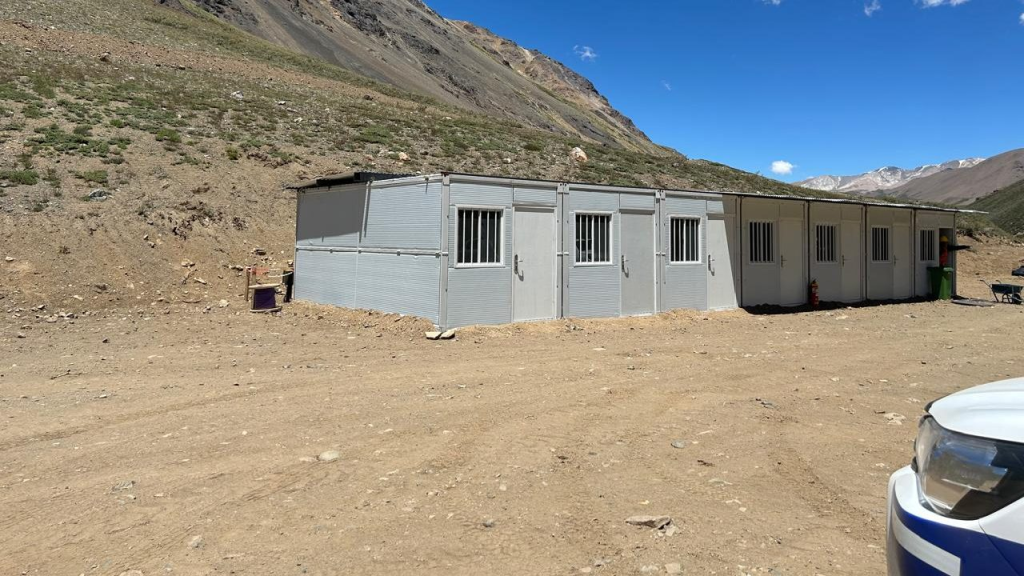
Following the completion of the first stage of technical analysis, Mendoza’s Mining Environmental Authority has issued the formal resolution initiating the evaluation process of the Environmental Impact Report (EIR) for Malargüe Western Mining District III (MDMO III).
The Mining Environmental Authority—composed of the Provincial Directorate of Mining and the Directorate of Environmental Management and Enforcement—has formally triggered the administrative procedure that moves the project into the next review phase. The Environmental Impact Report will now be evaluated by the School of Applied Sciences to Industry at the National University of Cuyo, and subsequently reviewed by 12 sectoral agencies.
The measure aligns with the announcement made by Governor Alfredo Cornejo during the opening of Argentina Mining Cuyo, the major mining conference that returned to Mendoza after 17 years last October. “We will begin the process for Western Mining District III, with 71 projects, each one evaluated with transparency and participation,” the governor stated, confirming the start of the district’s third phase.
With this resolution, the Mining Environmental Authority formally engages the School of Applied Sciences to Industry to begin the technical, environmental, and institutional review of each exploration permit included within the district, under the standards established by current regulations and with oversight from independent specialized bodies.
A Process Backed by Technical Expertise and Independent Institutions
The School of Applied Sciences to Industry at the National University of Cuyo will prepare the Technical Opinion required under Decree 820/06. The institution must submit its report within fifteen business days of receiving the documentation, ensuring an academic, professional, and independent review.
Once the technical opinion is incorporated, the file will be forwarded to various provincial and national agencies, each of which must issue reports within its area of jurisdiction.
The institutions involved in the review process include:
- General Department of Irrigation
- National Institute of Indigenous Affairs
- Sustainability Coordination of the Ministry of Energy and Environment
- Directorate of Hydraulics
- Directorate of Cultural Heritage and Museums
- Directorate of Protected Areas
- Directorate of Livestock
- Directorate of Planning
- Directorate of Biodiversity and Ecopark
- Argentine Institute of Nivology, Glaciology and Environmental Sciences (IANIGLA)
- Directorate of Hydrocarbons
- Argentine Institute for Research on Arid Zones (IADIZA)
Scope of Western Mining District III
The procedure covers 71 exploration projects that form part of a comprehensive planning strategy designed to organize mining activity, generate baseline data, and ensure environmental controls from the earliest stages.
Opening this evaluation phase means that each project must undergo successive reviews, address technical observations, and comply with specific requirements before any subsequent authorization can be granted.
Through this framework, the Province consolidates a model that combines productive development with public oversight, institutional participation, and scientific rigor in the assessment of each initiative.
What Is Malargüe Western Mining District?
Malargüe Western Mining District (MDMO) is the mining planning polygon defined by the Government of Mendoza in the Andean and south-central area of Malargüe Department. Within this defined area are multiple mining properties where exploration projects are organized.
The district model allows for a comprehensive environmental analysis by grouping initiatives within the same territory, all of which must pass through technical, sectoral, and public participation stages prior to any authorization.
The references to MDMO I, MDMO II, and MDMO III correspond to successive phases of project submissions within the same mining planning polygon.
Background: MDMO I and II
Previous phases followed the procedures established by provincial regulations.
MDMO I included 34 exploration projects. Each had its own Environmental Impact Report, independent technical opinion, sectoral agency review, and public hearing. The resulting Environmental Impact Declarations were later submitted to the Provincial Legislature for ratification.
MDMO II incorporated an additional 27 projects within the same district. The process once again included technical evaluation, sectoral reports, public hearings, and legislative review.
MDMO III now begins that same administrative pathway, ensuring transparency, institutional oversight, and citizen participation throughout the process.